
THE MASSACRE AT CHIOS
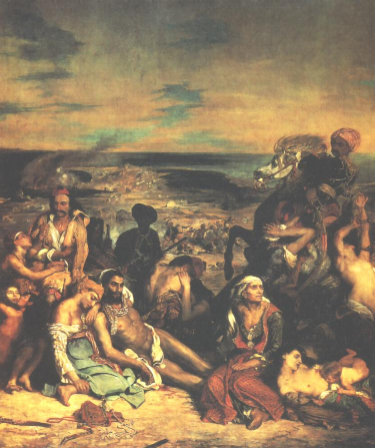
The Massacre at Chios (French: Scène des massacres de Scio) is the second major oil painting by the French artist Eugène Delacroix. The work is more than thirteen feet high, and shows some of the horror of the wartime destruction visited on the Island of Chios. A frieze-like display of suffering characters, military might, ornate and colorful costumes, terror, disease and death is shown in front of a scene of widespread desolation. The painting was completed and displayed at the Salon of 1824 and presently hangs at the Musée du Louvre in Paris.
WHERE’S THE EXAGGERATION?
By SOFIA KONTOGEORGE KOSTOS
As part of an
agenda to erase and manipulate historic truth on behalf of the Center for
Democratic Reconciliation for
Mr. Thanos
Veremis, professor of modern history at the
University of Athens; Mr. Dimitris Kastritsis, lecturer in Hellenic Studies and History; Ms.
Christina Koulouri, chair of the History Education Committee must be
looking at some other painting. It is claimed that French Artist Eugene
Delacroix’s painting of the Massacre
of Chios (1824)
at the
Actually, Delacroix’s Massacre of Chios
does not show 50,000
butchered fathers and husbands; it does not reveal women and children being
enslaved, raped, and murdered; it does not depict the
The following editorial
was excerpted from a long report in The Times of
THE TIMES,
EDITORIALS, P. 2 Issue 11661
Many details of the horrible
barbarities committed by the Turks at Scio [
A population of 120,000
souls has been reduced to about 900! and of them a
considerable portion were dying every day of pestilence produced by multitudes
of un- buried corpses. The most beautiful and flourishing island of the
Archipelago is a desert. The most civilized, cul- tivated, and interesting people, the flower of
Yet acts like these were palliated,
and by Englishmen: these acts were all but justified in Parliament, as being
provoked, or at least irritated by the Greeks.
When did the Greeks
deliberately and indiscriminately massacre the male inhabitants of an entire
province? When did the Greeks carry off tens of thousands of defenseless women
and innocent children, to glut their base avarice, or other execrable passions?
Will the destruction of a faithless garrison, after a storm which its treachery
had invited, be alleged as an equivalent for laying Scio [Chios]
in ashes, and burying fifty thousand fathers, and husbands in the ruins of
their own peaceful habitations?. . .
###
Transcribed
for educational and archival purposes only.